
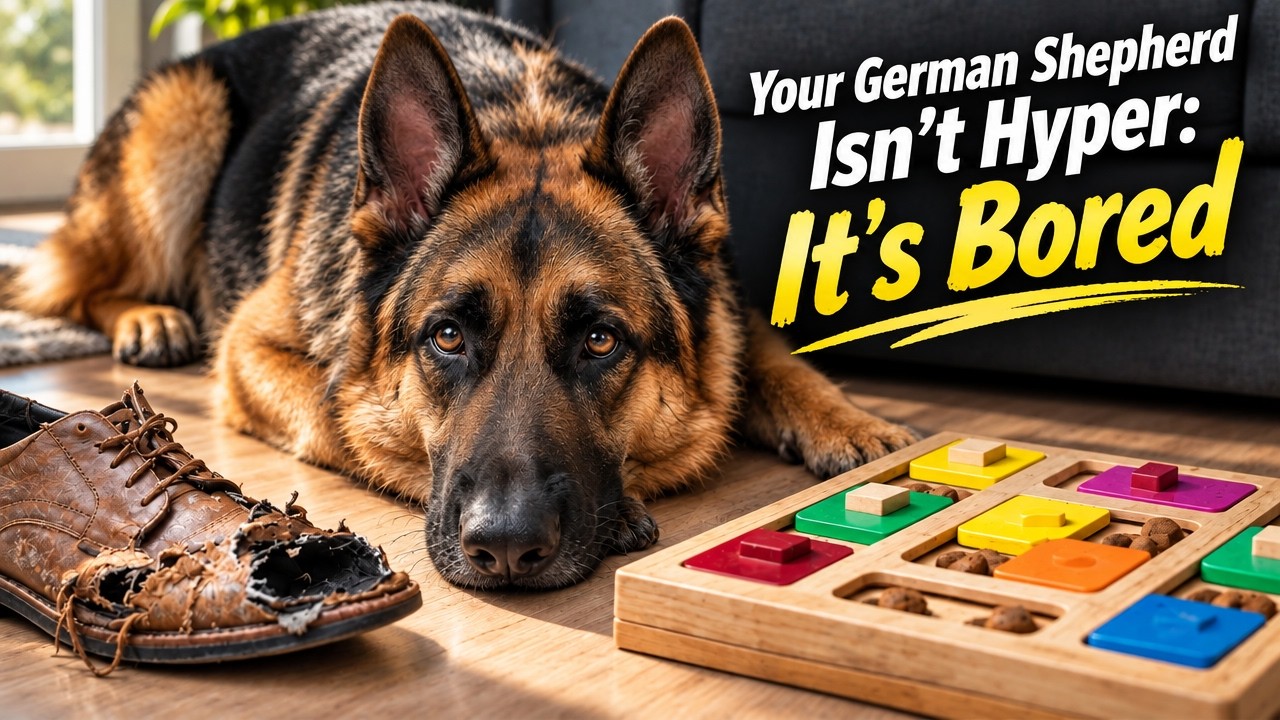
Your German Shepherd follows you from room to room. It notices every sound before you do. The second anything changes in the house, it reacts.
That isn't clinginess. It's a working mind looking for its next responsibility.
Let's look at why one of the world's greatest working dogs often struggles in modern homes. The German Shepherd wasn't created simply to obey commands. It was bred to think, adapt and work with humans under constantly changing conditions. Knowing that changes how you read nearly every behavior the breed shows.
A brain that expects a job
Lots of people believe the German Shepherd was bred to follow orders. In reality it was bred to solve problems. Whether managing livestock, assisting handlers or doing complex working roles, the dog couldn't wait for instructions every second. It had to observe, interpret, decide and then act.
Generation after generation, dogs that processed information quickly and adapted to changing situations became the foundation of the breed we know. That ability is still there. The work has gone.
Instead of managing sheep or assisting professionals, a modern Shepherd spends much of its life in homes, gardens and neighborhoods. And the environment keeps changing. Parcels arrive. People pass the window. Doors open. Kids run through the house. The brain immediately starts evaluating each change. Not because it enjoys worrying, but because that's what it was bred for.
The biggest challenge isn't a lack of exercise. It's a lack of meaningful responsibility.
It monitors, not just observes
Many breeds observe the world. A German Shepherd monitors it. Its nervous system builds a running picture of what normal looks like: where family members usually are, which sounds belong in the house, who walks past the fence every morning, how the daily routines unfold.
That internal map lets the dog spot change almost instantly. A different sound outside. An unfamiliar car. Someone approaching the property. A family member behaving unusually. None of these automatically cause stress. First they raise questions, and the brain starts collecting information before deciding if anything needs attention.
This is where owners misunderstand the breed. They only notice barking or pacing. The real process began much earlier, when the nervous system quietly registered that something no longer matched expectations.
No job? The brain makes one
A working dog rarely accepts having no purpose. If meaningful work goes missing, the nervous system redirects that motivation: watching the front window, following one family member everywhere, patrolling the garden over and over, reacting to every sound outside.
Seen from our side, that can look obsessive. Seen from the dog's side, it feels productive. The brain isn't trying to be difficult. It's trying to fulfill the role it inherited through generations of selective breeding.
That's why two German Shepherds in similar homes can behave quite differently. It isn't only training. It's whether the dog's need for responsibility found a healthy direction or whether its nervous system started inventing one.
Responsibility becomes identity
A German Shepherd doesn't just do a job. The job becomes part of how it understands the world. For generations this breed was rewarded for recognizing problems before people noticed: finding the weak spot in a flock, spotting unusual movement, handling uncertainty, deciding under pressure. That shaped more than behavior. It shaped identity.
Even now, many Shepherds seem happiest when they know exactly what's expected. Not because they enjoy orders, but because responsibility gives their nervous system direction. Without it the brain sets its own priorities: guarding the front door, watching every passer-by, checking every unfamiliar sound, shadowing the owner.
Those behaviors aren't signs of a dog trying to run the household. They're often signs of a working mind trying to justify its existence. That's why increasing physical exercise rarely solves it. The body may tire. The brain often stays unemployed.
Cooperation is the strength
Many powerful working dogs were bred to make independent decisions. The German Shepherd was bred to balance independence with cooperation. That blend made the breed so versatile. It could solve problems alone, but never stopped paying attention to its handler.
You can still see it. Many Shepherds constantly check where their owner is. They notice shifts in posture. They anticipate routines. They often react before a command is spoken. People call it exceptional obedience, but obedience is only the visible result. The deeper mechanism is partnership. The breed doesn't just want instructions. It wants to work with someone toward a meaningful objective.
When that partnership exists the nervous system gets steadier. When it's missing, many dogs go looking for purpose elsewhere.
Giving the job back
- Add tasks with real purpose: scent work, structured obedience with goals, sport, learning new skills.
- Make decisions clear, so the dog doesn't need to guard against everything.
- Work together, not just next to each other.
- Pair physical exercise with mental effort.
The biggest misunderstanding about the German Shepherd isn't believing it's energetic. It's believing exercise alone explains the breed. Energy was never the defining characteristic. Purpose was. Modern life often removes the responsibilities while expecting the instincts behind them to disappear. They don't. The work changes. The brain doesn't.
Once you see it, behavior that looked excessive starts to make sense. You're not looking at an overactive dog. You're looking at one of history's great working breeds trying to find a job that no longer exists.
Watch the video above, and tell us in the comments which working breed you want us to cover next.