
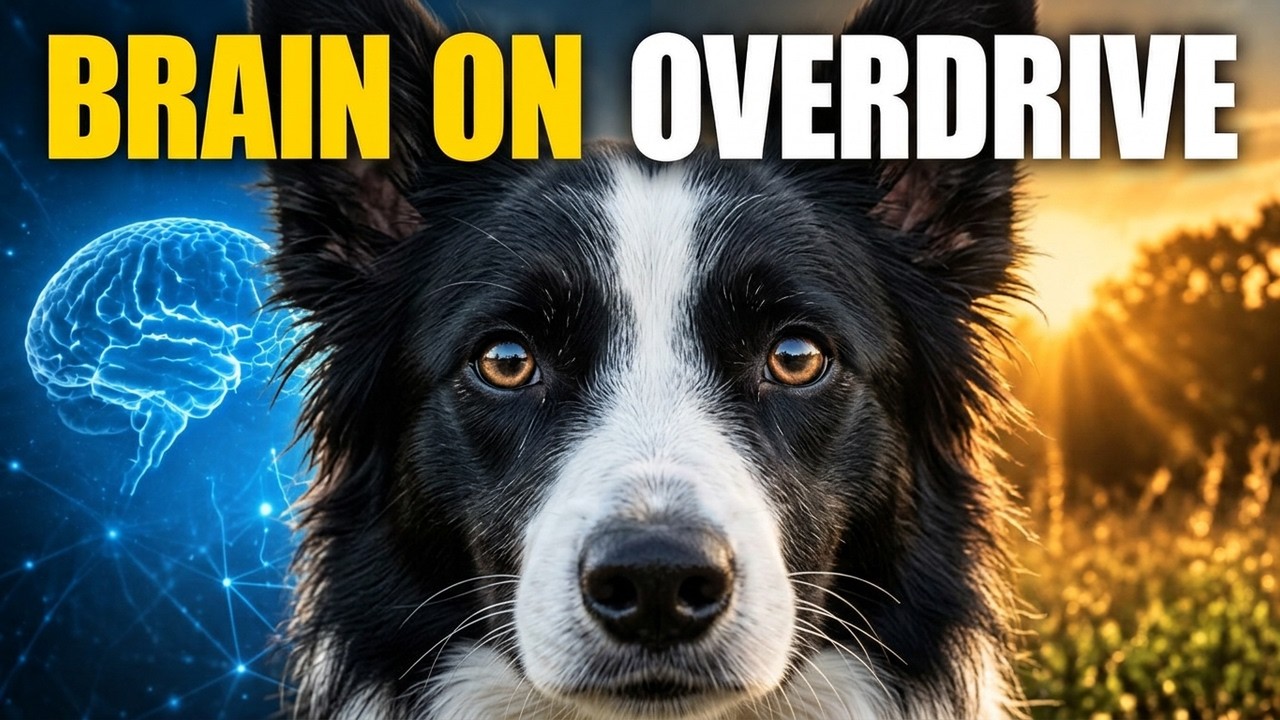
Almost everyone has heard the Border Collie pitch. Smartest dog on the planet, picks up a new command in a handful of repetitions, wants to please, never stops paying attention to you. And for the first few weeks with one, it can feel like the pitch was accurate.
Then the evenings start to get strange. The dog can't lie down. It's up every time a car door slams. It stares out the window like a security guard on a double shift. You've done the long walks, you've done the training, and the question creeps in: what did I do wrong?
Usually, nothing. You just bought a very specific kind of dog and gave it a very different kind of life.
Smart isn't the same as flexible
We tend to assume that an intelligent dog will adapt to anything. Clever people can adapt to new jobs, so clever dogs can adapt to new homes, right?
Not really. A Border Collie's intelligence is highly specialized. The breed's nervous system was shaped for constant analysis of the environment: spotting movement, judging distance, making decisions in real time. That isn't a dog that happens to enjoy learning tricks. It's a dog that can't stop processing the world.
So for this dog, stillness isn't rest. Silence isn't relief. When nothing meaningful is happening, the pressure doesn't drop. It builds.
What an apartment looks like to a working mind
Put that dog in a flat or a small house in a busy street and watch what happens. It starts creating tasks. It tracks every sound from the stairwell. It watches the window. It herds the kids, the cat, you, anything that moves.
From the outside this gets labeled as hyperactivity, or sensitivity, or "behavioral problems." Look at it from the dog's side and it's far simpler: a mind built for work, switched on, with nothing to point it at.
The exercise trap
The natural response is to add exercise. Longer walks, more running, more ball. Plenty of owners go through this phase, and plenty find it backfires.
You can end up with a dog who is fitter but not calmer. The body is more capable, the mind is just as busy. A tired Border Collie and a settled Border Collie are not the same animal.
What the breed seems to need is closer to a role:
- a structured routine that repeats, so the dog knows what's coming,
- tasks with a clear beginning and end,
- real consequences that connect to what the dog does,
- clear direction from you, delivered the same way each time.
Without those, tension returns quickly, no matter how many kilometers you covered.
It's a relationship, but a working one
Border Collies bond hard to their people. But it's not purely a cuddly bond. It's functional. The dog is looking to you for direction, and it reads clarity and consistency as leadership.
When the human side of that is vague or unpredictable, the dog fills the gap and starts managing things itself. That's often when the frustration shows up on both ends: you feel ignored, the dog feels unsupported.
What helps
None of this is exotic. It's mostly about giving the brain somewhere to go.
- Give it a job, a real one. Structured training sessions, a sport, scent or retrieval work. Something with rules and an end point.
- Build a daily rhythm and keep it. Same shape every day. The dog should be able to predict when work happens and when it's allowed to stop.
- Be consistent in how you ask. If cues mean different things on different days, the dog stops trusting your direction.
- Teach rest on purpose. Settling down is a skill. It doesn't appear automatically after enough running.
- Be honest about fit. If your life genuinely can't offer meaningful tasks, that's worth knowing before you get the dog, or worth acting on now.
So who is this breed actually for?
People who can organize their life around meaningful tasks. Livestock work, advanced sport, a daily system that repeats and gets harder over time. "Active" on its own isn't the criterion.
Border Collies aren't difficult dogs. They're very consistent biological systems, and when the environment and the genetics don't match, symptoms show up. Training can improve a lot of things, but it can't rewrite what the breed was built for. Behavior reflects context, not intention.
They're among the most capable working dogs in the world and also among the most often misplaced. Not because they ask too much, but because we ask them to be something they were never designed to be.
Watch the video above for the full walk-through. And if you live with a Border Collie and something feels off, tell us in the comments which part of the day is hardest. Your routine and setup might help someone else spot their own version of it.