
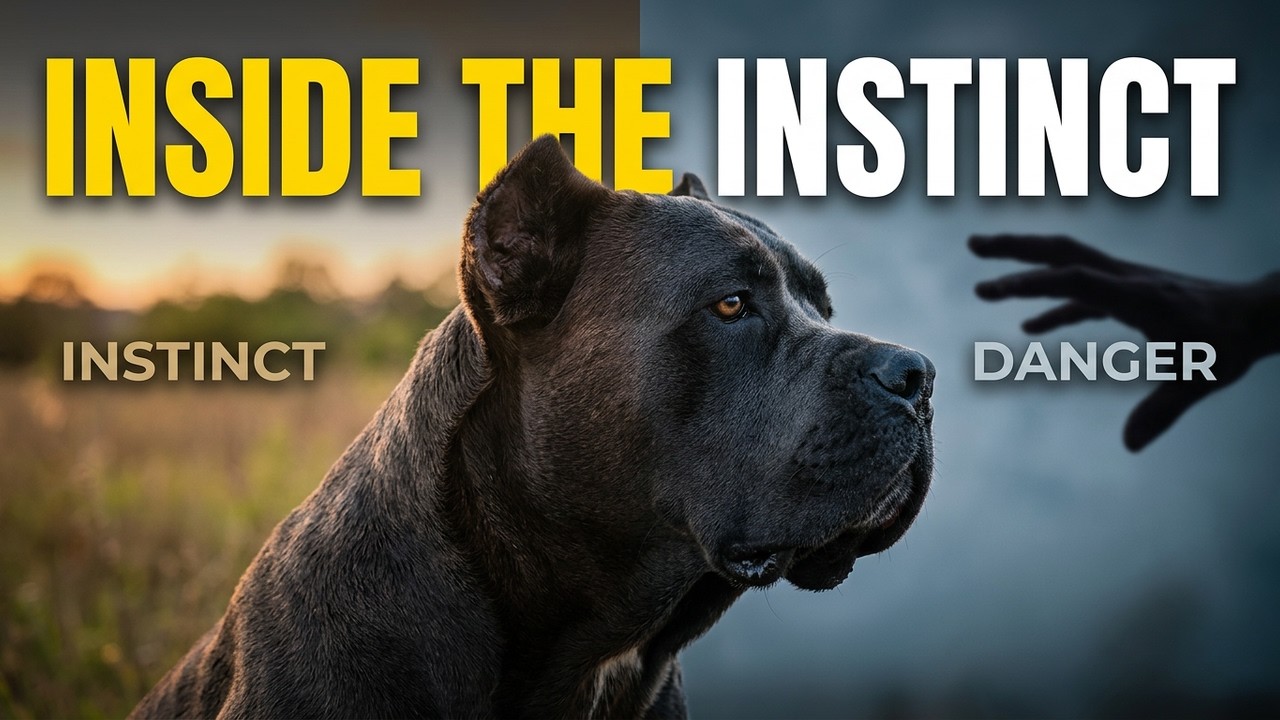
The doorbell rings. Your dog goes still before anyone else has reacted. A stranger passes the window. A guest steps through the door. None of it looks dramatic, and yet your dog's attention changes at once.
That isn't a bad temperament. It's thousands of years of selective breeding doing precisely what it was meant to do.
The Cane Corso isn't simply a big family dog. It's the descendant of Roman war and guardian dogs, with a nervous system that evolved to assess, predict and, if needed, confront danger. Understanding that mechanism changes how you read almost everything the breed does.
A brain built to decide
Most people believe a Cane Corso was bred to protect on command. In reality it was bred to decide before a command was ever given.
Working dogs in that role couldn't afford to hesitate. Whether guarding property, livestock or travelling with soldiers, they often had to interpret changing situations without waiting for orders. Generation after generation, dogs who evaluated threats quickly were chosen for breeding.
That ability is intact. Only the environment changed. Instead of unfamiliar soldiers or predators, a modern Corso evaluates delivery drivers, cyclists, visitors, barking dogs and movement outside the window. The brain runs the same process. Only the triggers differ.
Here's where owners misunderstand. A relaxed-looking Corso may be processing information long before any visible reaction. The bark isn't the beginning. It's often the end of a much longer, quieter process.
What it is looking for
A guardian's nervous system isn't searching for conflict. It's searching for predictability.
Say someone enters your home. If the movement follows familiar patterns, the brain predicts the outcome quickly. Muscle tension eases. Attention drifts back to normal. If the situation turns uncertain, everything changes: a visitor suddenly alters direction, someone approaches the owner unexpectedly, a strange sound comes from another room.
The dog doesn't instantly turn defensive. First, the brain gathers more information. Attention narrows. Movement slows. The body stiffens almost imperceptibly. The eyes stay on the source of uncertainty.
Many owners read those signals as stubbornness or dominance. In reality the nervous system is delaying its decision while it collects enough information to reduce uncertainty. This is the stage where most future reactions are actually decided.
Observation before protection
People tend to think protection starts with barking or lunging. For this breed, those are usually the end of the process, not the start. First the brain evaluates the environment. Then it compares the situation to previous experiences. Then arousal rises or falls depending on how predictable the event seems. Only if uncertainty remains unresolved does the body prepare for action.
That's why two people can watch the same situation and reach opposite conclusions. One sees a calm dog. The other sees a dangerous one. Meanwhile the dog may simply be completing an assessment it has made hundreds of times.
In practice, the quieter the dog gets, the more carefully it may be analyzing. Experienced owners notice small early changes: slower breathing, a body that stops moving, a head aligned with the object of interest. If enough information says the situation is safe, arousal drops before any protective behavior appears. The owner may never realize an entire evaluation just took place.
Loyalty isn't dependence
Many people expect a Cane Corso to behave like a dog that constantly seeks attention. Instead, this breed often prefers awareness over interaction. That isn't emotional distance. It's independence shaped by centuries of purposeful work.
A guardian couldn't rely on continuous guidance. It needed the confidence to observe, wait and decide when necessary. Today that can be easily misread. A Corso resting quietly across the room may still know where every family member is. Its attention moves long before its body does.
First-time owners are often surprised by this. The dog isn't ignoring the household. It's monitoring it. That's why the breed can look calm while staying mentally engaged for hours.
What to remember
The Corso wasn't created to look for conflict. It was created to recognize when conflict might become necessary. A dog that is always evaluating its surroundings doesn't need to be aggressive to seem serious. It carries a nervous system built for responsibility rather than constant social interaction.
The challenge of modern life isn't that the Corso changed. It's that the world around it did. Roman guardian instincts now operate inside suburban houses, apartment blocks and busy streets. Judge those instincts without knowing their purpose and normal breed characteristics get mistaken for behavior problems.
If you live with a Corso, learn to read the quiet stage. It tells you far more than the bark ever will.
Watch the video above, and tell us in the comments what your Cane Corso notices first.