
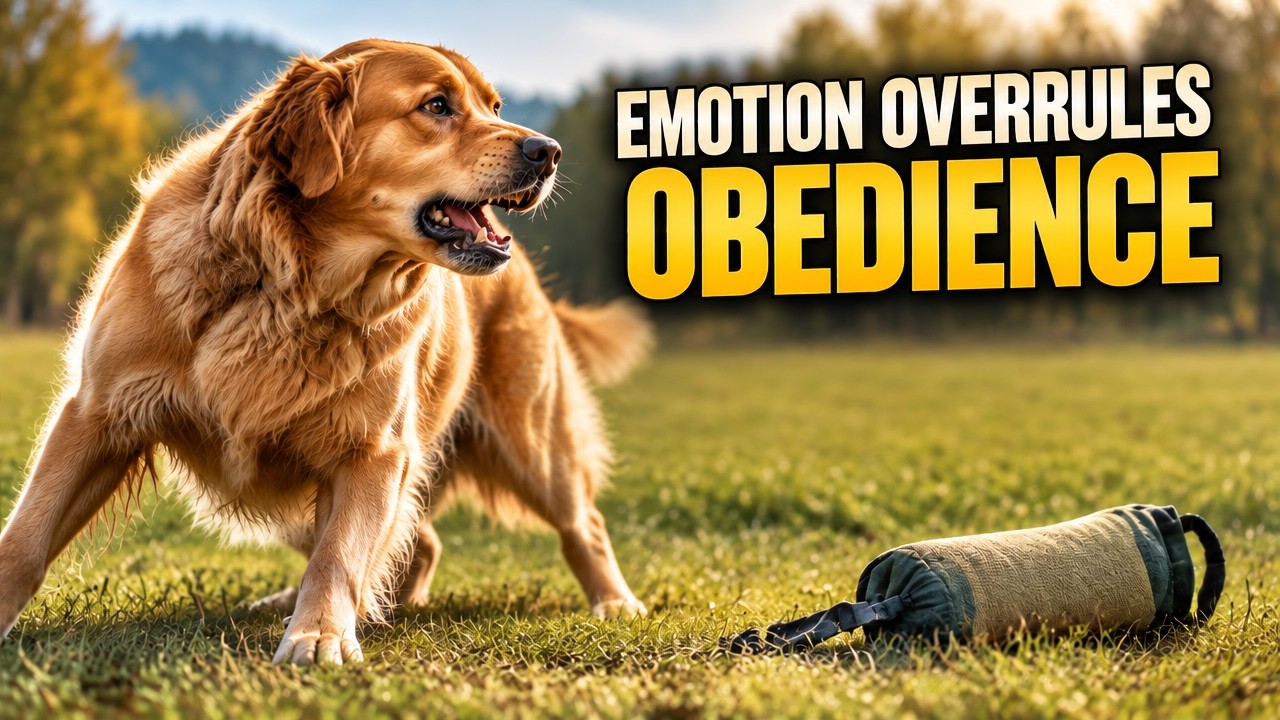
It usually starts with a good decision. You decide to work with your dog. Commands appear, rewards, repetition. For a while, everything looks better.
Then something shifts. The dog reacts harder. Gets wound up faster. Struggles more to come down. And you ask the obvious question: why is it getting worse when we're putting in so much effort?
It's one of the more uncomfortable questions in dog ownership, because the honest answer isn't "you're doing it wrong." It's more subtle than that.
Training as the universal fix
Lots of us treat training as the answer to everything. The dog doesn't listen? Training. The dog reacts? Training. The dog pulls? Training. The assumption underneath is that behavior is a learning problem: if the dog understood, it would behave.
And for a while that seems true, at least in controlled settings.
Behavior starts earlier than the command
Here's the thing. A behavior doesn't begin with a command. It begins with a state: tension, arousal, emotion. Training works on responses. But the real problem often shows up before that, at the level of the nervous system.
If that level gets ignored, the behavior comes back.
How arousal creeps up
A lot of training methods run on stimulation, treats, fast reactions, high engagement. And they work. But they also raise the dog's arousal. The dog starts operating higher and higher on that scale and gradually loses access to calm.
From the outside, that looks like progress. In reality, the problem has moved.
Why commands vanish where it's hard
A dog may respond in a calm room and fall apart in a difficult place. That isn't a knowledge gap. It's an access gap. When emotions cross a certain threshold, the brain switches to automatic reactions, instinctive ones, not learned ones. So a dog can know a command and still not be able to use it.
The loop
When behavior returns, the natural reaction is more of everything: more training, more repetition, more control, more intensity. And that pushes arousal up again.
Which gives you a loop. The more training, the less regulation.
So where is the real problem?
Rarely in the number of commands. More often it's the dog's ability to regulate itself: to move from aroused to calm, to stop without being stopped by someone else. That ability doesn't come from intense sessions. It comes from structure.
If you're stuck in this pattern, a few things are worth testing:
- Notice what state the dog is in before and after sessions. Wired, or settled?
- Add calm as a goal, not just correct responses.
- Look at the daily structure, meaning routines, rest and predictability, not only the training time.
- Keep intensity lower for a while and see what changes.
If the behavior is serious or sudden, a qualified behavior professional and a vet check are a good idea.
The takeaway
Training isn't bad. It just works exactly where you aim it, and that's not always where the problem is. If you work on behavior and ignore state, results will be temporary and may even look worse over time.
Watch the video above for the full argument. And if training seems to be making things worse, tell us in the comments which situation sets your dog off most. That's often where the real mechanism shows itself.