
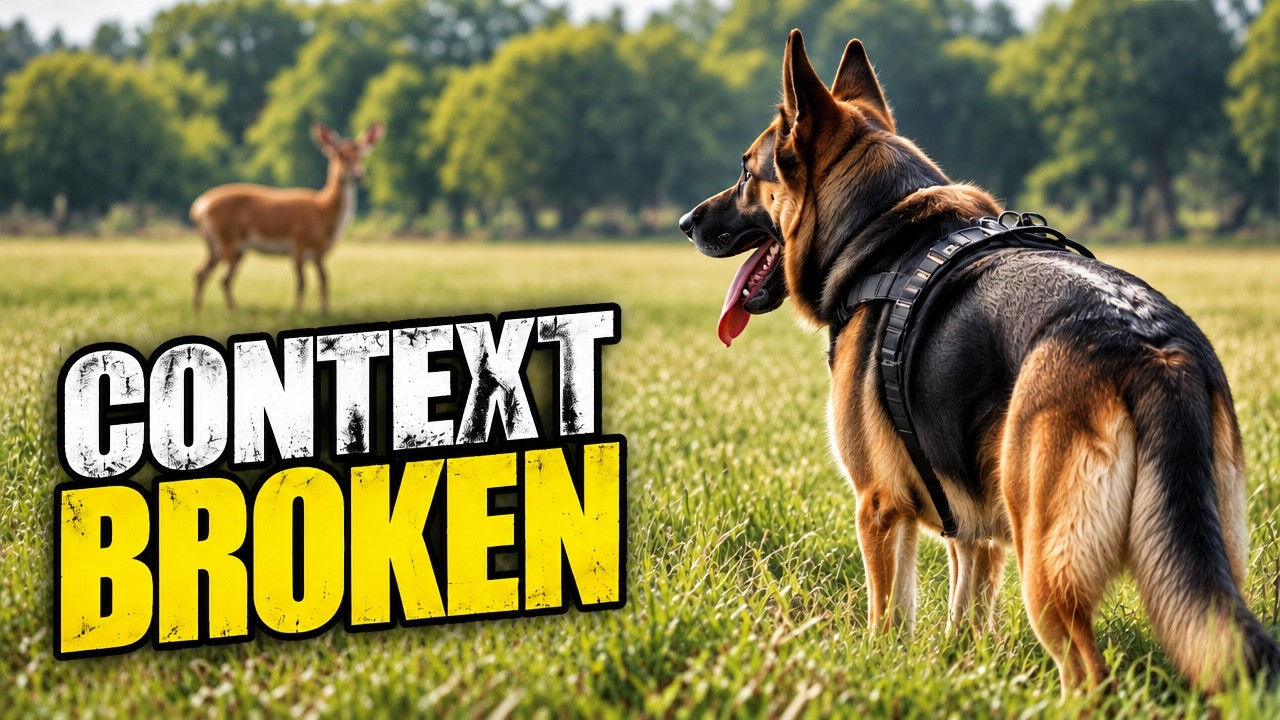
At home, your dog is a star. Sit, and the bottom hits the floor. Stay, and it stays. Come, and it's there before you finish the word.
Then you step outside, and it's like someone swapped the dog. You call, and nothing. You call again. Your dog hears you, you're fairly sure of that, and just keeps going. And somewhere in the back of your head a question starts forming: is he doing this on purpose?
Short version: no. Longer version below.
"He knows it, so he should do it"
Most of us assume that if a dog understands a command, it understands it everywhere. A word is a word. When the dog doesn't respond outdoors, frustration shows up fast: he's ignoring me, he's testing me, he's being stubborn.
But your dog didn't change his mind. The environment changed.
A command isn't a word
For a dog, a command is less like a word and more like a whole situation: the tone of your voice, how far away you are, the smells in the room, how excited the dog is. At home, all of that stays pretty stable. Outside, most of it simply isn't there anymore.
Imagine learning a task in a quiet room and then being asked to do it in the middle of a crowded, unpredictable space. You wouldn't call yourself disobedient if it went badly.
The outside is simply louder
For you, a walk is one thing. For a dog it's hundreds of signals at the same moment. Every smell carries information. Every movement can change a decision. Every sound pushes alertness a little higher.
A dog with its nose in the grass isn't refusing you. It's reading. And a pile of fresh scents is a more intense piece of information than a familiar word you've said a thousand times.
The mistake almost everyone makes
You repeat the command. Louder. Then firmer. It's a very natural thing to do.
But repeating something without changing anything doesn't make it stronger. It makes it weaker. If nothing happens after the word, the word turns into background noise, and your dog learns exactly that.
Why it all works at home
At home, the dog knows every sound, every smell, every movement. The world is predictable, so the command stands out. It's not that commands are stronger indoors. It's that the world is quieter.
Outside, the volume goes up, and a command that has never been practiced there loses its relevance.
What works over time
Dogs don't learn words. They learn context. If a command only ever exists in your living room, it stays a local skill, and each new place forces the dog's brain to make a fresh decision.
So spread it around:
- Move the same command through different places. Living room, hallway, garden, quiet street, busier street.
- Raise the difficulty a little at a time. Don't jump from the sofa to the park gate.
- Change the situation, not the volume. If your dog can't respond, reduce the distance or the distraction rather than shouting.
- Make commands lead somewhere. A cue should be followed by something meaningful.
After enough varied repetitions, the command starts to carry real meaning. Then the dog isn't reacting to a sound. It's reacting to understanding.
What this tells you
When commands vanish outside, your dog is not forgetting. It just doesn't recognize the situation as the same one. That's not disobedience. It's a lack of what we could call contextual transfer.
The dog isn't ignoring you. It's responding to a world that, right now, feels more important than a word it learned in one setting. If the environment changes, the way you teach has to change with it.
Watch the video above for the whole explanation, and if your dog is a model citizen at home but a stranger on walks, tell us in the comments where you notice it most.